Contractor Answering Service vs AI: Which Actually Books Jobs?
Live services charge $2.65-$4.90/minute; AI flat-rates from $199/month. See which contractor answering service actually books the job, not just takes a message.

A homeowner calls three contractors for a quote. The first two ring through to a message-taking service that promises a callback "within 24 hours." The third gets an instant answer and a confirmed time slot before the call even ends. Guess who gets the job.
In 2025, NextPhone analyzed nearly 1.5 million business calls and found 28.5% arrive outside standard business hours, with 34.8% of those after-hours callers showing real buying intent (NextPhone, 2025). The question isn't whether you need a contractor answering service. It's whether the one you pick just answers, or actually books.
Key Takeaways
- Live answering services bill $2.65-$4.90 per minute after included minutes, pushing realistic monthly costs to $1,500-$2,940+ (NextPhone, 2026).
- AI answering services run flat-rate, roughly $199/month for unlimited calls with no per-minute overage (NextPhone, 2026).
- 34.8% of after-hours callers show buying intent, and most of that volume never reaches a live agent outside staffed hours (NextPhone, 2025).
- The real gap isn't who answers — it's who writes the job onto the calendar in the same call versus who just relays a message.
- Complex, emotional, or negotiated calls still lean toward a human; routine booking and triage now lean toward AI.
Contractor Answering Service or AI Receptionist — Which Books More Jobs?
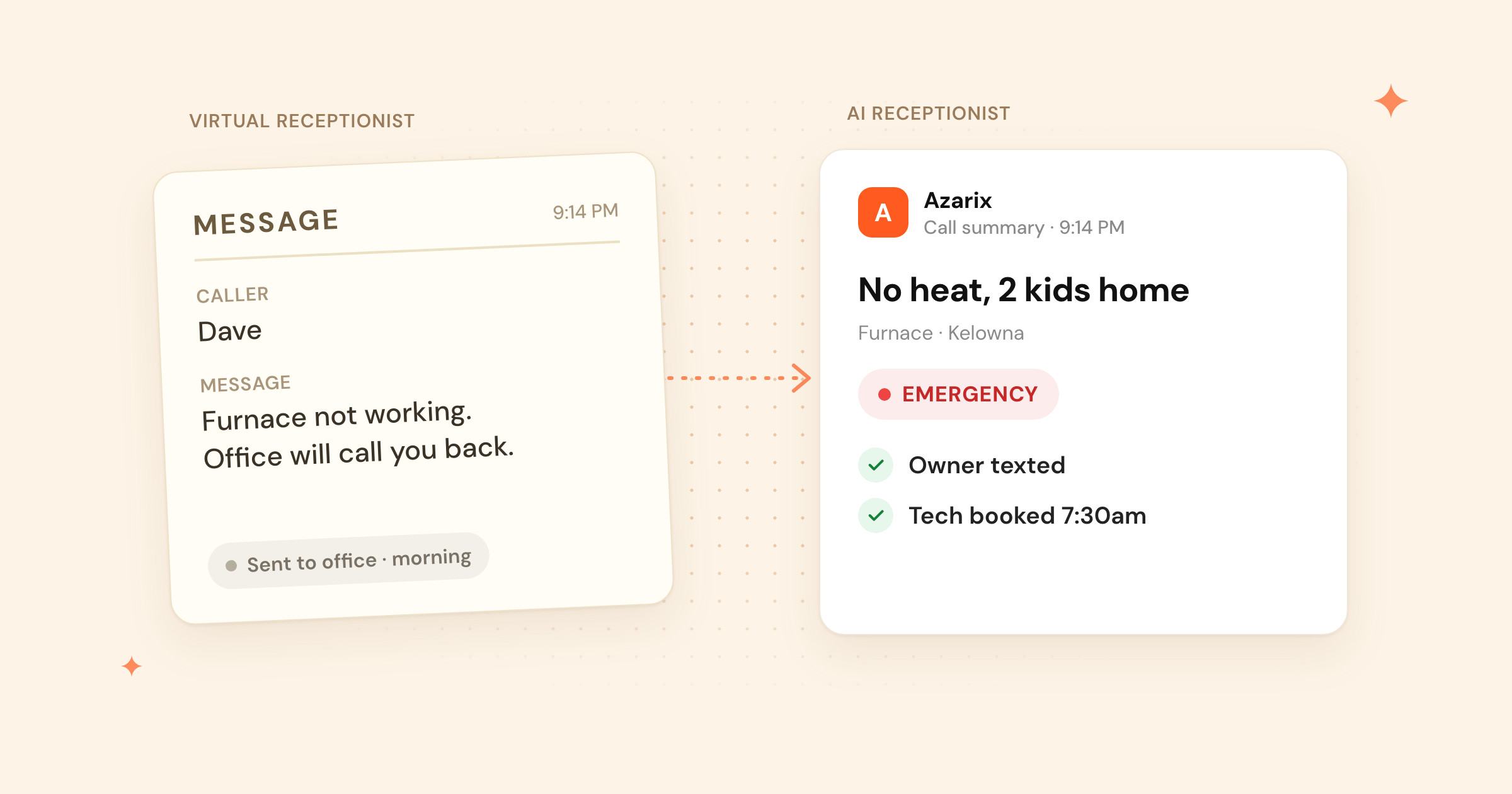
For most contractors, an AI answering service books more jobs because it writes directly into the calendar or CRM during the call instead of relaying a message for someone else to act on later. A live answering service still wins on nuance: complex, emotional, or negotiated calls where a human ear catches something a script can't.
That's the whole comparison in one paragraph. Everything below is the "why," the real numbers, and where each model actually falls short.
Isn't a message-taking service still better than nothing? Sure, but "better than voicemail" is a low bar, and it's not the bar a contractor competing on speed should be measuring against.
What Is a Contractor Answering Service, Exactly?
A contractor answering service is any system (live human, AI voice agent, or a hybrid of both) that answers incoming calls for a contracting business, captures the caller's details, and either books the job or routes it to the right person. What separates a good one from a phone tree isn't who or what picks up; it's whether the call ends with a confirmed next step.
Three models dominate the market in 2026:
- Live/human — a staffed call center answers per script, takes a message or does a warm transfer.
- AI — a voice agent answers instantly, runs structured intake or triage, and writes the result into your calendar or dispatch board.
- Hybrid — AI handles routine volume and booking; a human steps in for anything outside the script.
For the full breakdown of what a missed call costs before you even get to answering-service math, see what missed calls actually cost trade businesses.
How Do Human Answering Services Actually Work for Contractors?
A live answering service routes your calls to a shared pool of agents who follow a script, take down details, and either message you or transfer the call. Pricing runs $2.65 to $4.90 per minute once you're past the included allotment (NextPhone, 2026). At realistic contractor call volumes, that per-minute structure adds up fast.
NextPhone's 2026 pricing breakdown shows what that looks like across three well-known providers at roughly 200 monthly calls: Ruby Receptionists runs about $2,940/month once overage minutes hit $4.90 each, AnswerConnect lands near $1,950/month at $3.25/minute, and PATLive comes in around $1,590/month at $2.65/minute (NextPhone, 2026). That per-minute economics tracks with underlying labor cost. The U.S. median receptionist wage was $17.90/hour as of May 2024, before overtime, benefits, or the markup a staffed call center adds on top (U.S. Bureau of Labor Statistics, May 2024).
Here's the part that doesn't show up in a rate card: per-minute billing charges the most in exactly the months a contractor fields the most calls. Storm season, a cold snap, a sudden run of quote requests. That's backwards from what a growing business actually wants from its phone system.

Live services earn their cost on one thing: judgment. A distressed caller, a multi-part problem, or a customer trying to negotiate scope isn't a scripted flow. It's a conversation, and a trained agent can read what a script can't.
How Do AI Answering Services Actually Work for Contractors?
An AI answering service answers every call instantly, runs a structured intake or emergency-triage flow, and writes the outcome directly into your calendar or CRM. Flat-rate pricing runs around $199/month for unlimited calls, with no per-minute charge (NextPhone, 2026). No queue, no shift change, no overage bill waiting at the end of a busy month.
What "Booking the Job" Actually Requires
Answering the phone isn't the hard part. Any voicemail system does that. Actually booking a job in the same call requires three things working together: real-time calendar write access, service-area and pricing logic so the AI doesn't quote or schedule something it shouldn't, and a confirmation step so the caller leaves with a specific time, not a vague "someone will follow up."
An answering service that skips any one of those three is still just a message-taker with a better voice.
Contractor Answering Service vs AI — Side-by-Side Comparison
The clearest way to see the gap is side by side: AI wins on cost and booking speed, live wins on handling anything outside a script, and the honest answer for a lot of contractors is a hybrid of both.
| Live Answering Service | AI Answering Service | |
|---|---|---|
| Cost model | Per-minute, $2.65-$4.90/min after included minutes | Flat monthly, ~$199/mo unlimited |
| Realistic monthly cost | $1,500-$2,940+ at ~200 calls/month | Flat, no overage |
| Response time | Fast during staffed hours; queue possible at peak | Instant, every call, no queue |
| Books directly into calendar/CRM | Rarely, without custom integration | Yes, if configured for it |
| 24/7 coverage | Only if paying for round-the-clock staffing | Native, no extra staffing cost |
| Handles complex/emotional calls | Strong — trained human judgment | Weak-to-moderate; needs human handoff |
| Consistency across calls | Varies by agent and shift | Identical script every time |
When a Human (or Hybrid) Answering Service Still Wins
A live or hybrid answering service still wins for calls that need judgment a script doesn't have: a customer negotiating scope on a large commercial job, someone reporting property damage, a caller who's upset and needs to be heard before they'll listen to a triage question. No AI vendor claims otherwise, and any that do should be treated with skepticism.
The honest framing most contractors land on: AI handles routine bookings, basic triage, and after-hours capture, and a human takes the calls that genuinely need one. That's not a compromise. It's a deliberate hybrid strategy, and it's increasingly the default rather than the exception.
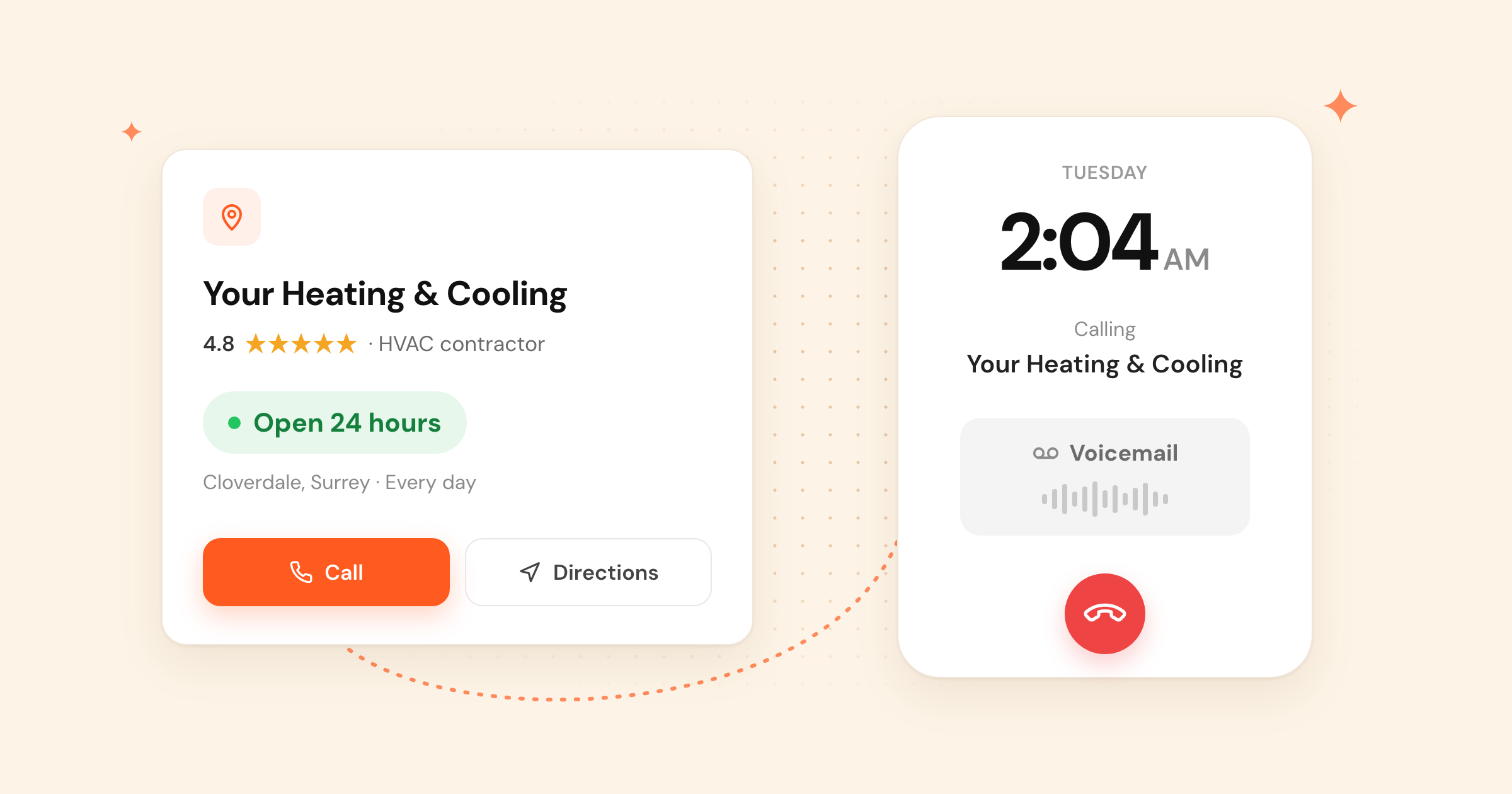
The contractors we talk to don't usually ask "AI or human." They ask "who's answering at 9 p.m. when I'm on a roof and my office line rings to nothing." For that specific question, AI is the answer almost every time. The human-judgment question only comes up after the call is already booked.
How Much Does Each Option Cost a Contractor Over a Year?
Run the annual math and the gap widens: a live service at $1,500-$2,940/month scales to $18,000-$35,000+ a year, while an AI service at roughly $199/month flat totals about $2,400 a year regardless of call volume (NextPhone, 2026).
One missed buying-intent call rarely costs a contractor more than a year of AI service. In 2025, Invoca's analysis of more than 60 million home services calls found 27% go unanswered entirely (Invoca, 2025), and a caller who hangs up rarely calls back. That's the number a per-minute bill is competing against.
NextPhone's 2025 dataset puts a rough number on it: a business fielding 500 monthly calls loses roughly 50 buying-intent calls to after-hours voicemail every month (NextPhone, 2025). Scale that against a per-minute vendor bill and the ROI case for flat-rate, always-on coverage is hard to ignore.
Neither pricing model is inherently "wrong." But only one of them gets more expensive the busier your best month is. That's the number worth running before signing anything.
How to Choose Between a Contractor Answering Service and AI
Pick based on four things: your call volume, how much of it is routine versus genuinely complex, what you already run for CRM/dispatch, and your comfort with an AI voice talking to your customers. Most contractors land on AI-first with a human escalation path, not one or the other exclusively.
Run through this before you sign anything:
- Call volume and seasonality — a per-minute bill hurts most exactly when volume spikes.
- Share of calls that are booking-ready vs. genuinely complex — the higher the routine share, the stronger the case for AI.
- Existing CRM/dispatch stack — does the service write directly into what you already use, or create a manual re-entry step?
- Budget ceiling — can you tolerate a variable per-call bill, or do you need a predictable flat cost?
- Brand tolerance for AI-voice contact — some customer bases care more than others; test it before committing at scale.
For a deeper look at what missed calls cost trade businesses in the first place, see calls going to voicemail: what it costs contractors.
Frequently Asked Questions
Does an AI answering service actually book jobs, or just take messages?
Direct-booking AI answering services write into your calendar or CRM in real time during the call, using service-area and pricing logic to confirm a slot. Message-only tools still require manual follow-up, which defeats much of the speed advantage AI is supposed to offer.
Is an AI answering service cheaper than a human one for contractors?
Usually yes: live services bill $2.65-$4.90 per minute past included minutes, pushing realistic monthly costs to $1,500-$2,940+, while AI runs flat-rate around $199/month regardless of volume (NextPhone, 2026).
Can AI answering services handle emergency contractor calls?
Yes. Most AI answering services use keyword and urgency triage to flag emergencies and warm-transfer or priority-alert the on-call technician, following the same logic a trained human dispatcher would use, just faster and without a queue.
What's a hybrid answering service?
A hybrid model uses AI to handle routine intake, triage, and booking, then hands off complex, emotional, or negotiated calls to a human agent. It's increasingly the default setup rather than a fallback, since it captures AI's cost and speed advantage without losing human judgment on the calls that need it.
How fast can a contractor set up an AI answering service?
Most AI answering service vendors offer same-day to a few-days onboarding, versus longer setup for a staffed human service that needs agent training on your specific business and script.
The Bottom Line
The real question was never "AI or human." It's "who ends the call with a job on the calendar." Live services still win on judgment for the calls that genuinely need a human ear, but at $2.65-$4.90 a minute, that judgment gets expensive fast. AI wins on cost, speed, and consistency for the routine volume that makes up most of a contractor's inbound calls.
If you're evaluating a contractor answering service, start with one that shows you exactly how a call turns into a booked job, not just a message in your inbox. Trade-specific breakdowns for plumbing and electrical contractors cover the same decision in more detail. See how Azarix handles it: book a demo.
About the author: James Smith is the founder of Azarix, an AI answering service built for trades businesses.
Sources
- NextPhone, "Live Answering Service: AI vs Live Pricing 2026," retrieved 2026-08-11, https://www.getnextphone.com/blog/live-answering-service
- NextPhone, "37 AI Receptionist Statistics 2026 [347K Calls Analyzed]," retrieved 2026-08-11, https://www.getnextphone.com/blog/ai-receptionist-statistics
- U.S. Bureau of Labor Statistics, Occupational Outlook Handbook — Receptionists, May 2024, https://www.bls.gov/ooh/office-and-administrative-support/receptionists.htm
- Invoca, "See How Much Missed Sales Calls Cost Home Services Businesses," retrieved 2026-08-11, https://www.invoca.com/blog/how-much-missed-sales-calls-cost-home-services-businesses