Calls Going to Voicemail? Here's What It Costs Your Trade Business
Missed calls cost HVAC, plumbing, and roofing contractors real jobs. Learn how to calculate your weekly revenue at risk and when voicemail stops being enough.

If calls go to voicemail during business hours or after hours, your trade business may be losing jobs to the next contractor who answers. For HVAC, plumbing, electrical, and roofing companies, one missed urgent call can be worth $500–$950. To estimate the cost, multiply missed calls per week by the percentage that are real job opportunities and your average job value.
Key Takeaways
- In 2024, Invoca's analysis of 60 million+ home service calls found 27% go unanswered. Fewer than 3% of callers routed to voicemail leave a message (Invoca, 2024).
- 85% of callers who don't reach a live person will not call back. They contact a competitor (BIA/Kelsey; primary study not publicly available, widely cited in home services industry research).
- The average booked HVAC job is worth $450–$950. One recovered call per month can pay for a full month of coverage.
- Voicemail isn't the problem on its own. The problem is urgent callers who won't wait and competitors who will answer.
- Track missed calls for one week before buying anything.
The missed call you never see
You're under a sink. Or on a roof. Or talking to a customer while your truck sits in the driveway. Your phone rings. You can't answer it. It goes to voicemail. You'll call back after this job.
By the time you do, they've already called someone else.
That's the problem with missed calls in the trades: the loss is invisible. No one sends you a message that says "I hired your competitor." You just never hear from them again. Your phone still feels busy. You still close jobs. You just never see the ones that slipped away.
This post will help you estimate how much that invisibility is costing you, and decide whether doing something about it is actually worth it.
Why voicemail feels harmless
Voicemail feels fine because the feedback loop is broken. You get busy. Calls come in. Some get answered, some don't. You call people back when you can. The business keeps running. No one shows you a list of leads you didn't close.
Here's what makes that picture misleading:
- No one complains when they choose a competitor. They just go.
- Your staff might say "we call everyone back." That doesn't mean callers waited.
- Completed jobs feel like enough. You don't see the pipeline that never formed.
- The phone still rings, so the phone feels like it's working.
Voicemail doesn't just miss calls. It hides demand. A business losing jobs to unanswered calls looks completely normal in the job log. It's only the conversion rate that's silently broken. That's why owners underestimate the problem until they actually run the math.
In 2016, a study of 85 small businesses across 58 industries found that 62.2% of inbound calls went unanswered: 37.8% sent to voicemail and 24.3% receiving no response at all (411 Locals, 2016). That baseline hasn't gotten better for most owner-operators running lean shops.
The four types of missed calls
Not every missed call matters the same way. Here's how to break them down so you know where to focus:
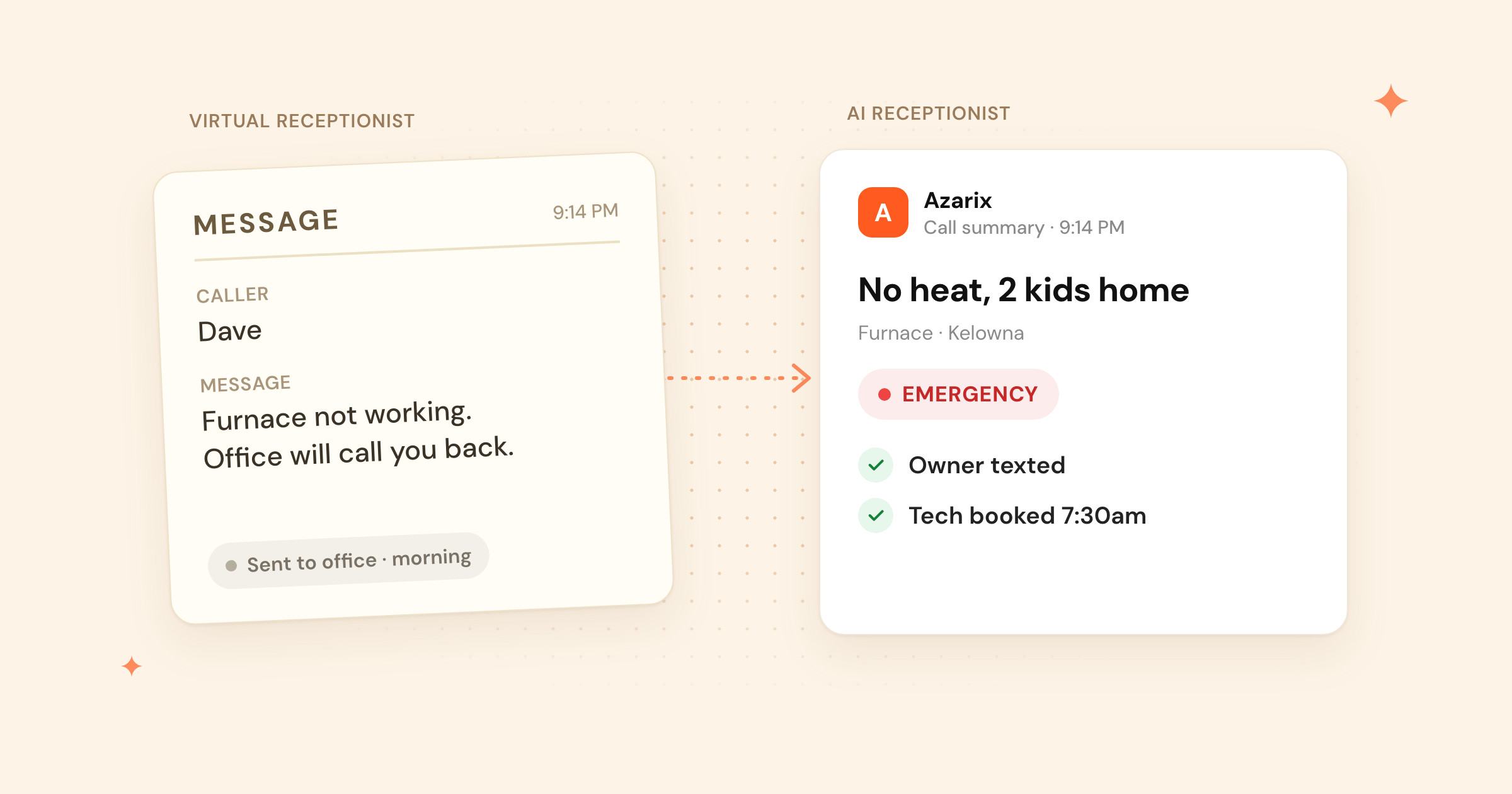
1. Emergency jobs Burst pipe. Furnace out in January. No heat. Electrical issue. These callers need someone right now. If you don't answer, they call the next contractor on the list, within 30 seconds. These are your highest-value, highest-risk missed calls. (See how a plumbing answering service handles a burst-pipe call for a trade-specific breakdown.)
2. Same-week bookings The customer wants service soon but isn't in crisis. They'll wait a few hours, but not overnight. If you follow up by end of business, you can often still win this one.
3. Price shoppers Lower intent. They're calling three contractors for quotes. Missing this call may not cost you a job. Don't panic about every call in this category.
4. Existing customers They already know you. They trust you. Missing their call is a relationship and reputation risk. Slow callbacks from existing customers turn into bad reviews.
The goal isn't to rescue every missed call. It's to prioritize emergency and booking calls during the hours you're most likely to be unavailable: job sites, driving, and evenings.
Simple formula: what do missed calls cost?
In 2024, Invoca's analysis of 60 million+ home service calls found that 27% go unanswered (Invoca, 2024). For a trades business fielding 20–30 inbound calls per week, that's five or more calls disappearing every week. Fewer than 3% of those callers leave a voicemail. Most just hang up and call a competitor.
Here's the formula:
missed calls per week × percentage that are real job opportunities × average job value = weekly revenue at risk
Example with conservative numbers:
- 5 missed calls per week
- 30% are real job opportunities
- $700 average job value
- 5 × 0.30 × $700 = $1,050/week in revenue at risk
This isn't guaranteed lost revenue. It's the pool of opportunity you're exposing to competitors. Even recovering one job per month changes the break-even math significantly.
How fast does callback speed matter? In 2007, a Lead Response Management study of 15,000+ leads across six companies found that responding within 5 minutes versus 30 minutes made contact 100x more likely and increased the odds of qualifying the lead 21x (MIT/InsideSales.com, Dr. James Oldroyd, 2007). For emergency trades calls, "same day" is already too slow. The practical benchmark is minutes, not hours.
If you can't return a call quickly during peak hours, voicemail stops being a message-taking tool. It becomes a sales bottleneck.
When voicemail is still fine
Voicemail may be good enough if:
- You get fewer than 5 inbound calls per week.
- You don't offer emergency or after-hours service.
- You or someone on your team can return calls within minutes, every time.
- You have a receptionist covering all your high-value hours.
- Your average job value is too low to justify the cost of additional coverage.
If that's your business, stop here. Voicemail is working fine.

When voicemail starts costing you jobs
Check these against your own business:
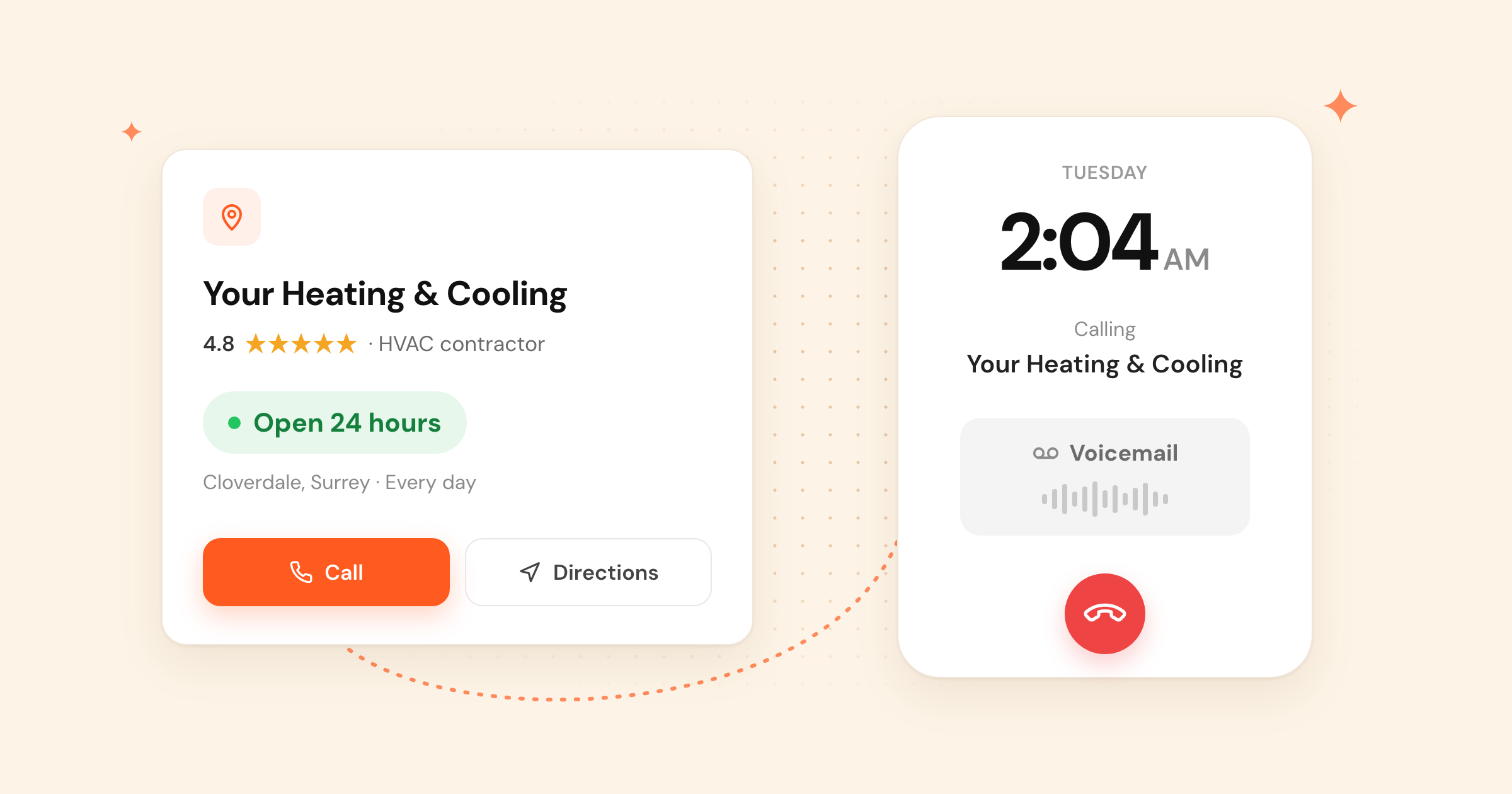
- You advertise 24/7 service but stop answering at 5 or 6 PM.
- Reviews mention "hard to reach," "never called back," or "went with someone else."
- You regularly call people back the next morning.
- One booked job is worth more than a month of call coverage.
- You miss calls while you're on job sites or driving.
- Busy season floods you with more calls than your office can handle.
- Your receptionist covers business hours but not evenings or weekends.
Azarix finding: In a review of 74,761 Google reviews across 2,936 Canadian plumbing and HVAC businesses in 13 cities, Azarix identified 769 reviews with "went elsewhere" or "called someone else" signals, customer feedback where the reviewer explicitly noted contacting the company but not receiving a timely response before moving on. 49% of emergency-trade businesses in this dataset showed closed hours by 6 PM despite advertising 24/7 availability. (Azarix review research, 2025–2026.)
If three or more of the checklist items above apply to your business, voicemail is no longer neutral. It's actively working against you.
Five ways to stop losing calls
There's no single right answer here. The right option depends on your call volume, average job value, and how your business is set up. Here's an honest comparison:
| Option | Best for | Main limitation | Fit for small trade business |
|---|---|---|---|
| Better voicemail greeting | Low call volume, non-urgent work | Doesn't help callers who need a live answer now | Good baseline, not enough for urgent leads |
| Faster callback process | Shops where someone responds within minutes | Breaks when the owner is on tools, driving, or asleep | Useful if consistently followed |
| Human receptionist | Steady daytime volume | Expensive and usually not 24/7 | Strong experience if affordable |
| Traditional answering service | After-hours message-taking and overflow | May charge per minute; often doesn't book jobs | Helpful for coverage, quality varies |
| AI receptionist | Answering, qualifying, and booking when staff can't pick up | Not ideal for very low volume or complex judgment calls | Best when one booked job covers the monthly cost |
A better voicemail greeting is the cheapest option. Works for low call volume and non-urgent work. Won't help the furnace-out caller who needs someone on the phone at 8 PM.
A faster callback process works if someone can genuinely respond within minutes, every time. Breaks down the moment you're on tools, mid-conversation with another customer, or asleep. Hard to sustain reliably at scale.
A human receptionist gives the best caller experience if you can afford it. Full-time hire runs $40,000–$55,000/year in Canada. Most receptionists work 9–5, leaving evenings, weekends, and peak emergency windows uncovered.
A traditional answering service handles after-hours message-taking and overflow. Per-minute billing can get expensive on longer calls. Many services take a message but don't book the job, meaning another callback step before anything is confirmed.
See Azarix's pricing for what an AI receptionist plan actually costs before you sign anything. Plans start at C$99 a month for about 100 calls (200 minutes), and your first 10 calls are free.
An AI receptionist makes sense when calls need to be answered 24/7, callers need to be qualified, and jobs need to be booked without a human in the loop. Best fit for businesses where one booked job covers the monthly cost. Low volume or calls requiring real-time judgment: go with a human service.

What to look for in a call coverage solution
Before choosing any option, run through this checklist:
- Can it answer after hours?
- Can it distinguish an emergency from a routine booking request?
- Can it book appointments, or does it only take messages?
- Does it send you a summary after each call?
- Can it handle your specific business hours and service area?
- Will callers know they're speaking with AI?
- Are calls recorded with proper disclosure?
- Is pricing clear and predictable — no per-minute surprise bills?
- Does one booked job cover the monthly cost?
That last question is the most practical filter for a small trade shop. If the answer is yes, the math is simple.
Quick self-audit for your business
Before spending anything, find out where you actually stand. Don't guess.
Answer these this week:
- How many inbound calls do you get per week?
- How many go unanswered?
- How fast do you typically call back?
- What's your average job value?
- Do you have after-hours demand?
- Do your reviews mention communication problems?
- What percentage of calls become booked jobs?
Track calls for one week using this template:
| Date | Time | Answered? | Caller type | Urgent? | Callback time | Booked? | Outcome |
|---|---|---|---|---|---|---|---|
| Mon | 7:20 PM | No | New lead | Yes | Next morning | No | Called someone else |
| Tue | 11:00 AM | Yes | Existing customer | No | — | Yes | Booked Thursday |
| Wed | 6:45 PM | No | New lead | Yes | 7:10 PM | No | No answer on callback |
If you don't know these numbers, start tracking for one week before buying anything.

Where Azarix fits
If your audit shows missed urgent calls, slow callbacks, and after-hours demand that nobody's covering, that's the specific gap Azarix is built for.
Azarix is built for Canadian trades businesses that need calls answered and jobs booked when the owner or receptionist can't pick up. The phone gets answered. The caller gets qualified. The job gets booked when appropriate. You get a summary.
If call volume is very low, or every call genuinely requires complex human judgment in the moment, a human answering service makes more sense. But if you advertise 24/7 and urgent calls are reaching voicemail after 5 PM, that's a predictable, recurring revenue leak, not an edge case.
In our dataset, one booked job typically covers the cost of a full month of coverage. The break-even isn't a complicated equation.
Get in touch to see if Azarix fits your call volume
Final takeaway
Voicemail isn't automatically bad. It becomes expensive when urgent, high-value callers reach it and call another contractor before you respond.
According to BIA/Kelsey research, 85% of callers who don't reach a live person will not call back. They call a competitor instead. For HVAC, plumbing, electrical, and roofing businesses where emergency jobs are worth $450–$950 each, that isn't an abstract risk. It's a weekly revenue problem hiding in a dashboard you're not looking at.
Start by tracking missed calls for one week. Run the formula. Then choose the simplest coverage option that pays for itself. That's the whole calculation.
Try it yourself
Run the formula from the "Simple formula" section with your own numbers. If the weekly revenue at risk is larger than the monthly cost of coverage, the math is in your favour. Contact us if you want to see how Azarix handles a trade business call before committing to anything.
Frequently asked questions
How much does a missed call cost a contractor?
It depends on your trade and your average job value. For HVAC, plumbing, electrical, and roofing businesses, the average booked service call is worth $450–$950 based on Service Roundtable benchmarks and Angi pricing data (ainora.lt, 2026). If 30% of your missed calls are real job opportunities and you miss five per week, that's roughly $675–$1,425 in weekly revenue at risk. Run the formula with your own numbers first.
Is voicemail bad for a small trade business?
Not on its own. Voicemail works fine if you get fewer than five inbound calls per week, don't offer emergency service, and can return calls within minutes every time. It becomes a problem when urgent callers reach voicemail, can't wait, and call the next contractor on the list, which happens more often than most owners realize.
What should I do if I miss calls while on job sites?
Start by tracking how many calls you're actually missing and what type they are. If emergency or same-week booking requests are among them, a callback process alone won't solve it. Callers don't wait. Options include forwarding to a mobile number with response windows you protect, a traditional answering service for overflow, or an AI receptionist to answer and qualify calls while you're on the tools.
Is an answering service worth it for contractors?
It depends on call volume and job value. If one booked job is worth $500+ and you're missing one per month, a coverage solution usually pays for itself. Traditional answering services run $135–$450/month (HouseCallPro, 2025); AI options typically run $50–$300/month. Use the missed revenue formula first. If the weekly revenue at risk is larger than the monthly cost, the math is in your favour.
When does an AI receptionist make sense?
An AI receptionist makes sense when calls need to be answered 24/7, your inbound volume is consistent enough to justify the cost, and one booked job covers the monthly fee. It's not the right fit for very low call volume or situations where every call needs a human making real-time judgment calls. For most HVAC, plumbing, electrical, and roofing shops taking more than 10 calls per week, it's worth running the numbers.
How fast should I call back a missed lead?
Research from the MIT Lead Response Management Study (Dr. James Oldroyd, InsideSales.com, 2007) found that responding within 5 minutes versus 30 minutes made contact 100x more likely and qualifying the lead 21x more likely. For emergency trades calls, calling back next morning is almost always too late. The practical target is minutes, not hours. If you're regularly calling back the next day, you're not in a callback competition. You're starting from scratch on leads that already moved on.
About the author: James Smith is the founder and CEO of Azarix, an AI answering service built for Canadian trades businesses.
Sources
- Invoca, "How Much Missed Sales Calls Cost Home Services Businesses," 2024. Retrieved 2026-06-30. https://www.invoca.com/blog/how-much-missed-sales-calls-cost-home-services-businesses
- 411 Locals, "Small Business Owners Don't Answer 62% of Phone Calls," January 18, 2016. Retrieved 2026-06-30. https://411locals.us/small-business-owners-dont-answer-62-of-phone-calls/
- MIT/InsideSales.com, Lead Response Management Study, Dr. James Oldroyd, 2007. Retrieved 2026-06-30. https://www.mortech.com/hs-fs/hub/25649/file-13535879-pdf/docs/mit_study.pdf
- ainora.lt, "HVAC, Plumbing and Electrical Service Call Statistics 2026," 2026. Retrieved 2026-06-30. https://ainora.lt/blog/hvac-service-call-statistics-2026
- HouseCallPro, "How Much Does an Answering Service Cost?" 2025. Retrieved 2026-06-30. https://www.housecallpro.com/resources/how-much-does-an-answering-service-cost/
- BIA/Kelsey, missed call competitor research. Cited via PATLive and industry sources, 2019–2024. Primary PDF unavailable publicly.
- Azarix internal review dataset, 74,761 reviews across 2,936 Canadian plumbing and HVAC businesses (769 "went elsewhere" mentions), 2025–2026.