Plumbing Answering Service: Never Miss a Burst Pipe Call Again
27% of home services calls go unanswered. See how a plumbing answering service captures burst-pipe emergencies, what it costs, and how to pick one.

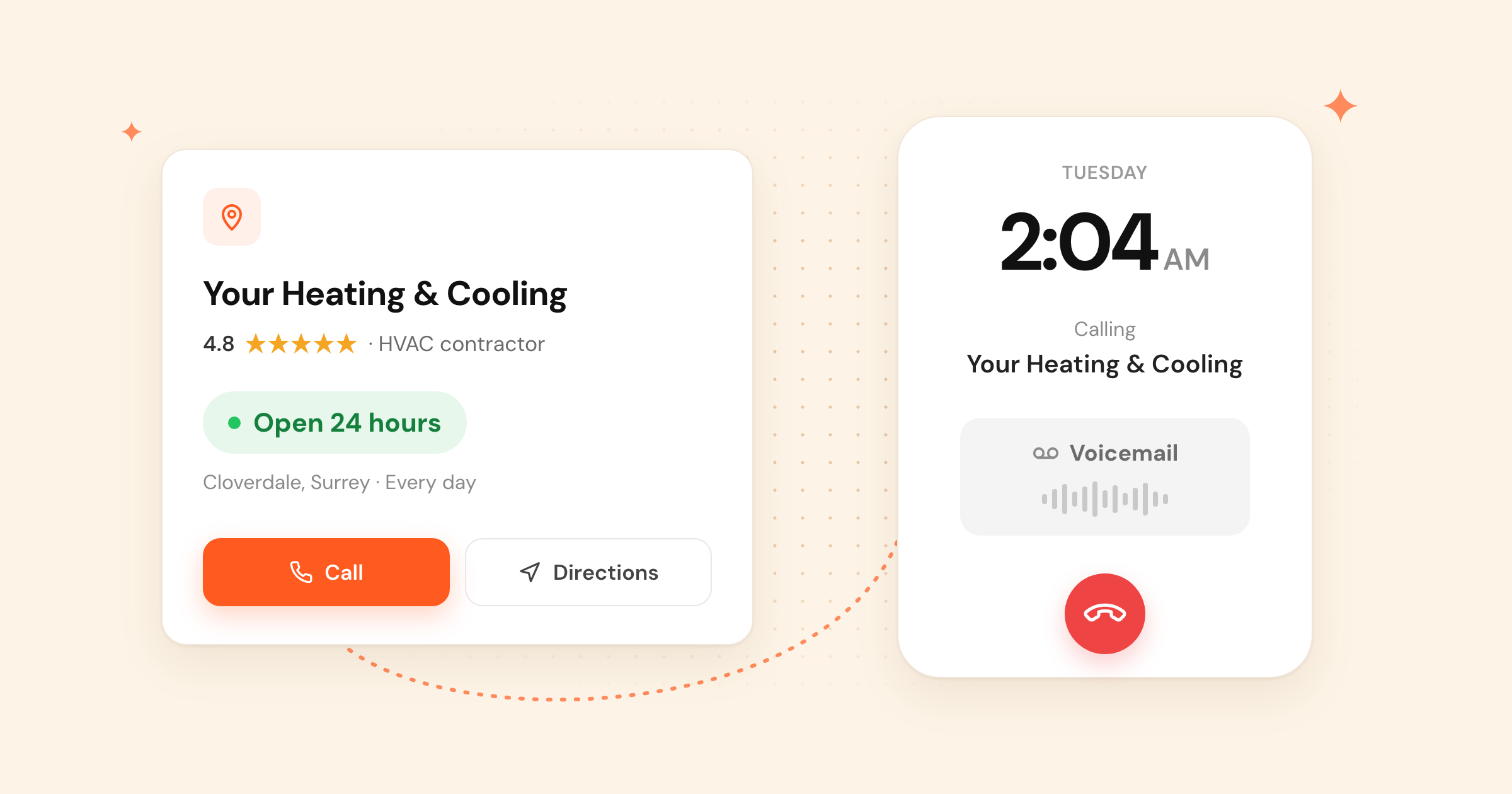
It's 11 p.m. A homeowner's basement is filling with water from a burst pipe. They call your shop. It rings four times and hits voicemail. They hang up and call the next plumber on the list, the one who answers. In 2025, Invoca's analysis of more than 60 million home services calls found 27% go unanswered (Invoca, 2025). A plumbing answering service exists to close that exact gap.
Key Takeaways
- In 2025, Invoca found 27% of home services calls go unanswered. That's roughly 1 in 4 burst-pipe callers hearing a ring, then nothing (Invoca, 2025).
- An average plumbing job is worth $340, with emergency after-hours surcharges adding $100–$300+ on top (HomeAdvisor, 2026).
- Published AI answering pricing runs $49–$299/month flat-rate (Rosie, GoodCall), versus a median $17.90/hour for a live receptionist (BLS, May 2024).
- Per-minute billing structurally penalizes the exact months you need coverage most: the ones with the most emergency calls.
- Trade-specific triage, FSM integration, and published pricing separate a real plumbing answering service from a generic call center.
What Is a Plumbing Answering Service?
A plumbing answering service answers every incoming call for a plumbing business 24/7, captures job details, and routes emergencies to the right technician, so a burst pipe at midnight doesn't sit in a voicemail box until morning. It can be live, AI-driven, or a hybrid of both.
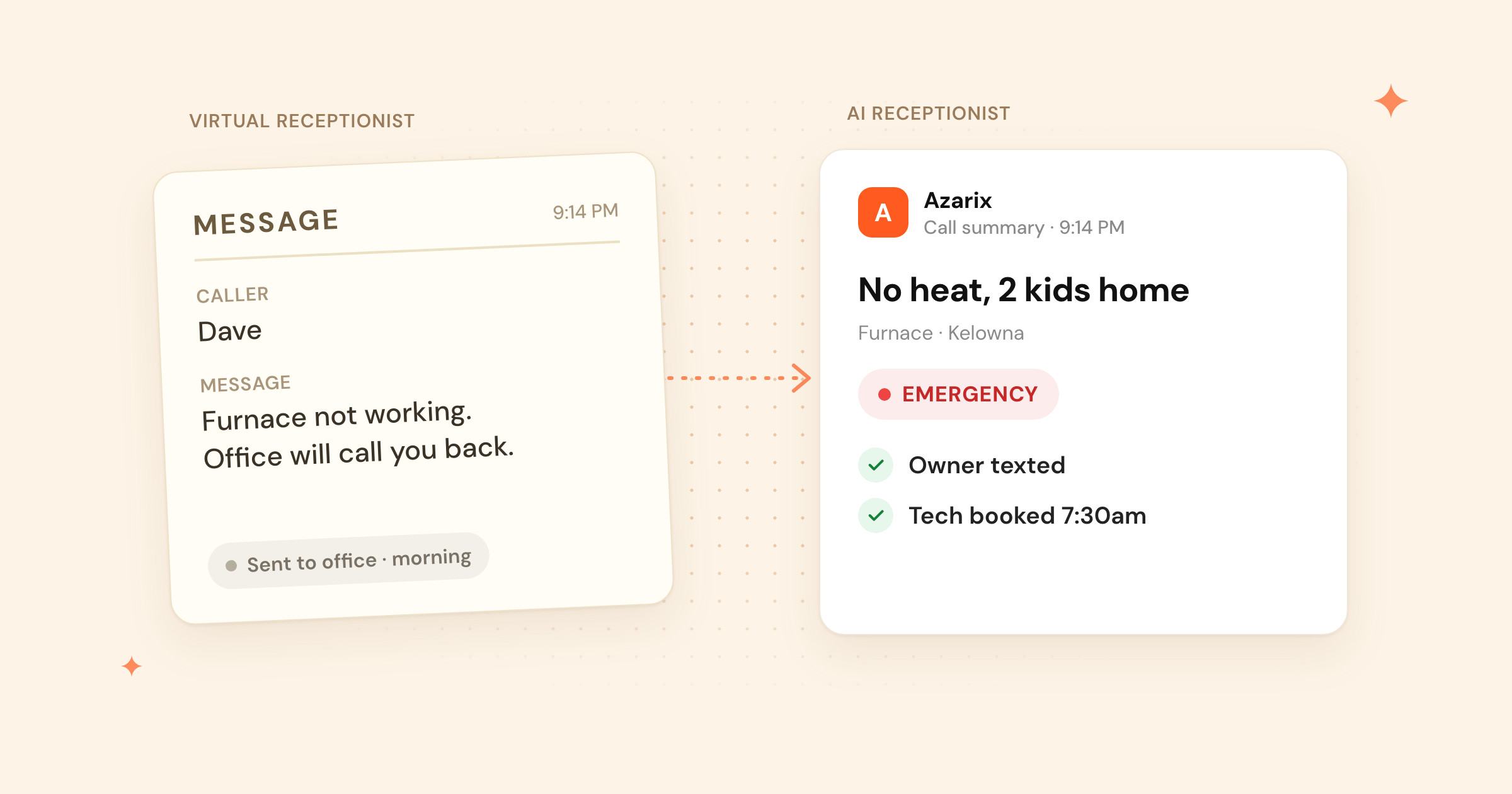
The distinction that matters isn't just "someone picks up." A generic answering service handles any business the same way. A plumbing-specific one asks the right triage questions: is water actively flowing, is it near an electrical panel, has the main shutoff been located, before deciding whether the call is a dispatch-now emergency or a next-morning appointment.
That's a meaningfully different job than answering calls for a dentist's office or a law firm.

Isn't voicemail technically an answering service, too? Not in any way that matters. Voicemail doesn't triage, doesn't dispatch, and doesn't stop the caller from hanging up and dialing your competitor next. See what missed calls actually cost trade businesses for the full breakdown.
Why Missed Calls Cost Plumbing Companies Real Money
In 2025, Invoca found 27% of calls to home services businesses go unanswered, and most of those callers don't leave a voicemail, they just call the next number (Invoca, 2025). For a plumbing business, that 27% isn't evenly distributed across routine and emergency calls. Emergencies are disproportionately after-hours, exactly when staffed phone lines are thinnest.
The dollar value at stake is concrete. HomeAdvisor's 2026 pricing data puts the average plumbing job at $340, with diagnostic or service-call fees of $100–$250 and emergency after-hours surcharges adding another $100–$300 or more on top (HomeAdvisor, 2026). A missed burst-pipe call isn't a missed $340 job. It's a missed emergency-rate job, often the highest-margin work a plumbing company books all week.
There's a second cost that doesn't show up in any missed-call report: Google's own Local Services Ads documentation states that a business's "responsiveness to customer inquiries and requests" factors into how it ranks (Google Local Services Ads Help). A pattern of missed calls doesn't just lose the one job. It can quietly work against future lead volume too.
How Does a Plumbing Answering Service Handle a Burst Pipe Call?
A plumbing answering service picks up the call instantly, runs a short emergency-triage script, and either dispatches the on-call technician or books the next available slot, all inside the first 60-90 seconds. That speed is the whole point: the caller with water actively flowing doesn't want a callback, they want confirmation someone is coming.
The call flow usually looks like this:
- Instant pickup — no ring-until-voicemail delay, day or night.
- Emergency triage — is water actively flowing, is a shutoff valve accessible, is the leak near electrical systems.
- Dispatch or schedule — urgent calls route to the on-call tech by text or app alert; non-urgent calls get booked into the existing schedule.
- Confirmation and summary — the caller gets a confirmation message, and the office gets a call summary synced to whatever job platform the business already runs.
What Happens After Hours vs. During Business Hours
During business hours, a plumbing answering service typically handles overflow: calls the front desk can't get to fast enough. After hours, it becomes the entire phone system, since there's no front desk to fall back on.
Live Receptionist vs. AI Answering Service vs. Voicemail: Which Wins More Jobs?
Voicemail loses the emergency call outright: callers with an active leak rarely wait for a callback. A live receptionist adds a human touch but costs roughly what a $17.90/hour median receptionist wage implies for full-time coverage (U.S. Bureau of Labor Statistics, May 2024). An AI answering service answers instantly at a fraction of that cost and doesn't have a shift change.
Each model has a real tradeoff, not just a marketing angle:
| Voicemail | Live Receptionist | AI Answering Service | |
|---|---|---|---|
| Response time | None — caller leaves a message or hangs up | Fast during shifts | Instant, 24/7 |
| Cost | "Free," but the hidden cost is every lost job | ~$17.90/hr median wage, before overtime and benefits | $49–$299/month flat-rate (published vendor examples) |
| Coverage | Whenever no one picks up | Limited to staffed hours | 24/7/365, no sick days or holidays |
| Consistency | None | Depends on staffing and training | Same triage script, every call |
Rosie publishes a $49–$299/month tiered rate card by minutes included, and GoodCall publishes $79–$249/month per agent with unlimited minutes (Rosie; GoodCall) — both real, on-page numbers, not a "request a quote" form. Azarix publishes its plans the same way on its pricing page: Starter is C$99 a month for about 100 calls (200 minutes).
The plumbing owners we talk to don't frame this as "AI versus human." They frame it as "who's picking up at 2 a.m. when I'm asleep and my part-time front desk isn't scheduled." That's the actual comparison worth making.
What Should You Look for in a Plumbing Answering Service?
The right plumbing answering service does more than pick up the phone. It needs trade-specific triage scripting, integration with the job platform you already use, and pricing you can see before you sign. ServiceTitan alone serves more than 100,000 service professionals across HVAC, plumbing, and electrical trades (ServiceTitan), and Jobber serves over 400,000 (Jobber). If your answering service doesn't sync with the platform you dispatch from, you've just added a manual step during an emergency.
Non-negotiables to check before signing:
- Trade-specific scripting — burst pipe, clogged drain, and water heater failure aren't the same triage conversation.
- FSM/CRM integration — direct sync with Jobber, ServiceTitan, or Housecall Pro, not a manual re-entry step.
- Transparent, published pricing — a real rate card, not a "book a demo" form.
- Bilingual support — if your service area has meaningful demand for it.

Questions to Ask Before You Sign
- How long is the contract, and what does it take to cancel?
- What happens during call-volume spikes — a storm, a cold snap, a burst-pipe surge?
- Can you get call recordings and transcripts, not just summaries?
- How long does onboarding actually take before you're live?
How Much Does a Plumbing Answering Service Cost?
Published pricing for AI answering services runs roughly $49–$299 a month flat-rate, based on Rosie's tiered plans ($49/$149/$299 by minutes) and GoodCall's per-agent plans ($79/$129/$249) (Rosie; GoodCall, current). AnswerNet advertises plans "starting under $100/month" for smaller operations but routes buyers to a custom-quote form rather than a real rate card (AnswerNet).
Neither published rate card charges per minute. Both are flat monthly tiers. That matters more than it sounds like: a per-minute or per-call billing model charges the most in the exact months a plumbing business fields the most emergency calls, which is precisely backwards from what a buyer wants. Look for flat or tiered pricing before you look at the headline number.
Frequently Asked Questions
What is a plumbing answering service?
A plumbing answering service answers every call to a plumbing business 24/7, captures job details, and routes emergencies to the right technician. It can be live, AI, or hybrid, and it's built specifically to triage plumbing emergencies like burst pipes rather than generic customer inquiries.
How does a plumbing answering service handle emergencies like burst pipes?
It picks up instantly, runs a short triage script to confirm severity, and dispatches the on-call technician by text or app alert within roughly 60–90 seconds. Non-urgent calls get scheduled into the existing calendar instead of interrupting dispatch.
Is AI good enough to handle plumbing emergency calls?
AI answering services now handle real-time triage and dispatch for plumbing calls, with published vendors like Rosie and GoodCall charging $49–$299/month flat-rate for the service (Rosie; GoodCall). Complex or ambiguous calls typically hand off to a live team member.
How much does a plumbing answering service cost?
Published AI answering pricing runs $49–$299 a month flat-rate based on current vendor rate cards (Rosie; GoodCall). Live-staffed lines cost closer to a receptionist's wage, with the U.S. median at $17.90/hour (BLS, May 2024).
Does a plumbing answering service integrate with Jobber, ServiceTitan, or Housecall Pro?
A trade-specific answering service should sync directly with the job platform you dispatch from. ServiceTitan alone serves more than 100,000 service professionals (ServiceTitan). If your answering service can't push a call summary straight into that system, someone's re-typing it by hand during an emergency.
The Bottom Line
Missed emergency calls aren't a rounding error. They're jobs worth $340 on average, often more once the after-hours surcharge applies, going to whichever plumber answers first. Voicemail and understaffed lines both leave that gap open. What closes it is trade-specific triage, real integration with your job platform, and pricing you can actually see before you sign.
If you're evaluating a plumbing answering service, start with a provider that publishes real pricing and shows you exactly how a burst-pipe call gets handled before you commit. See how Azarix handles emergency plumbing calls: book a demo.
About the author: James Smith is the founder of Azarix, an AI answering service built for trades businesses.
Sources
- Invoca, "See How Much Missed Sales Calls Cost Home Services Businesses," retrieved 2026-07-02, https://www.invoca.com/blog/how-much-missed-sales-calls-cost-home-services-businesses
- HomeAdvisor, "How Much Does It Cost to Hire a Plumber?," retrieved 2026-07-02, https://www.homeadvisor.com/cost/plumbing/hire-a-plumber/
- Insurance Information Institute, "Facts + Statistics: Homeowners and Renters Insurance," retrieved 2026-07-02, https://www.iii.org/fact-statistic/facts-statistics-homeowners-and-renters-insurance
- Google Local Services Ads Help, "About ad rankings," retrieved 2026-07-02, https://support.google.com/localservices/answer/7527305?hl=en
- U.S. Bureau of Labor Statistics, Occupational Outlook Handbook — Receptionists, May 2024, https://www.bls.gov/ooh/office-and-administrative-support/receptionists.htm
- ServiceTitan, Press page, retrieved 2026-07-02, https://www.servicetitan.com/press
- Jobber, About page, retrieved 2026-07-02, https://www.getjobber.com/about/
- Housecall Pro, About page, retrieved 2026-07-02, https://www.housecallpro.com/about/
- AnswerNet, Plumbing Answering Service page, retrieved 2026-07-02, https://answernet.com/industries/plumbing/
- Rosie, Pricing page, retrieved 2026-07-02, https://www.heyrosie.com/pricing
- GoodCall, Pricing page, retrieved 2026-07-02, https://www.goodcall.com/pricing