24/7 Live Answering Service: AI That Sounds Human
AI is redefining 24/7 live answering. Compare human vs AI live pricing, response time, and job-booking rate. Which fits your trade business?

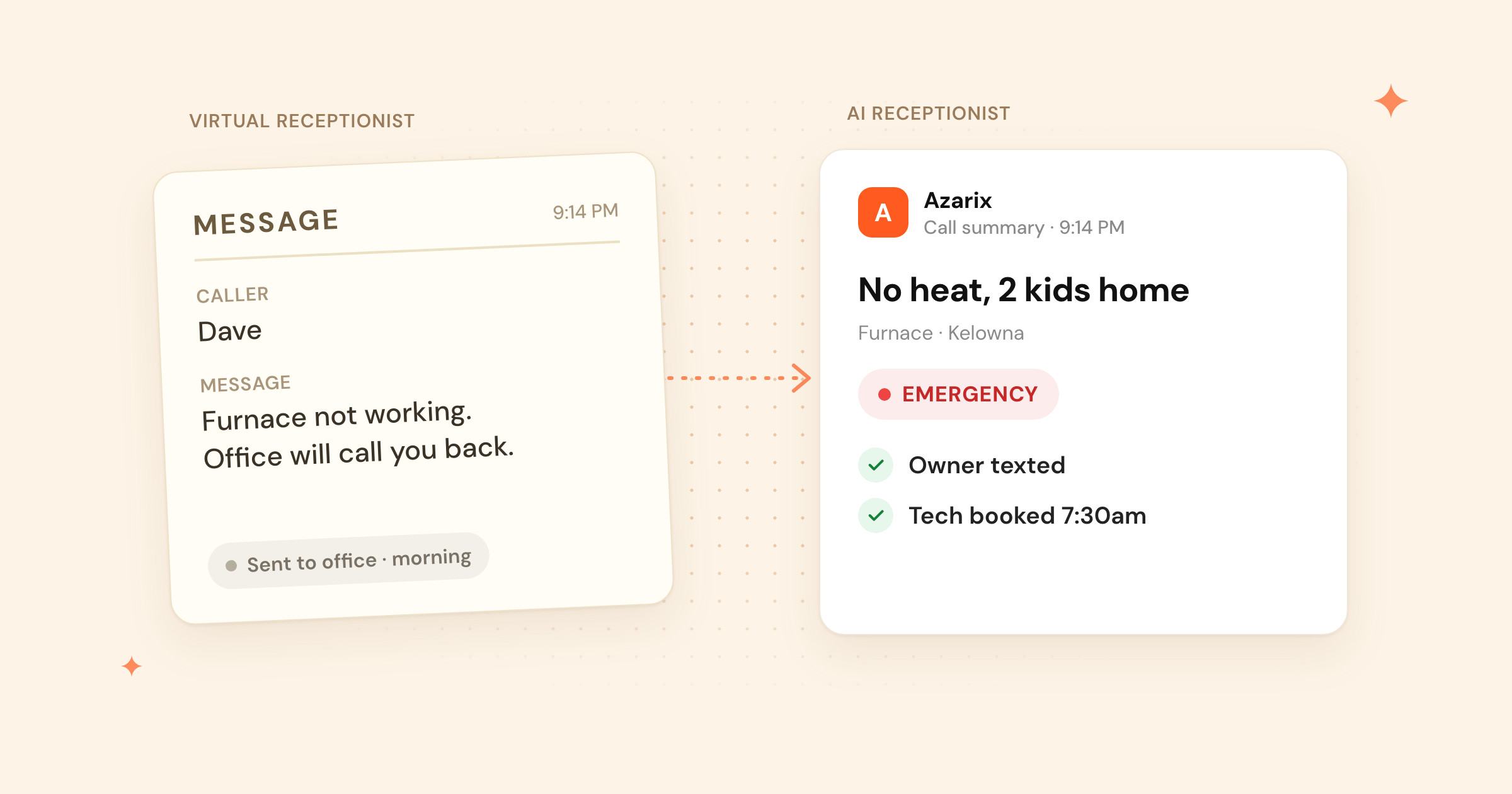
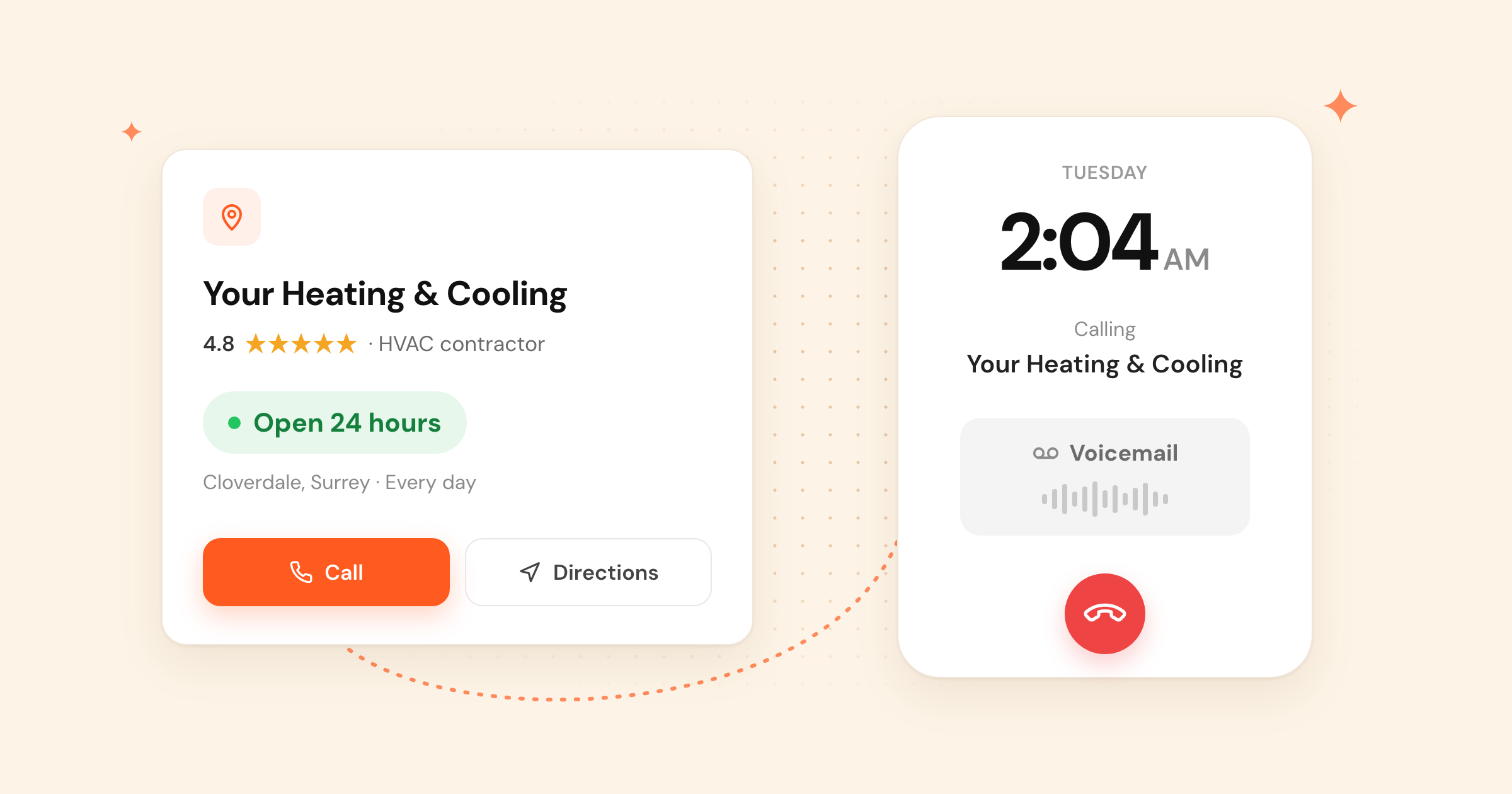
It's Saturday, 6:47 p.m. A homeowner's furnace just died. They call your shop, hear four rings, then a voicemail message they don't leave. In under 30 seconds, they've dialed the next number in the Google results, and that one answered. Roughly 85% of callers whose calls aren't answered never call back, per research from BIA/Kelsey widely reported across the industry (Contractor In Charge summary, 2024). A 24/7 live answering service exists to close that gap. What "live" means, though, has changed.
Key Takeaways
- Roughly 85% of callers whose calls aren't answered never try you again, per BIA/Kelsey research widely cited across the home-services industry (Contractor In Charge, 2024).
- Industry data reports 62% of calls to small service businesses go unanswered during business hours (Contractor In Charge, 2024).
- Google's Local Services Ads name "responsiveness to customer inquiries" as a ranking factor: "Missed calls may negatively affect your responsiveness" (Google LSA Help).
- Modern AI receptionists start at $49/mo, versus roughly $245/mo entry for human live services per Nextiva's 2026 roundup. Flat-rate AI removes the busy-season pricing trap.
- The US Bureau of Labor Statistics reports a median hourly wage of $18.27 for receptionists as of May 2025 (BLS). Loaded with benefits, that's roughly $55,000 a year for 9-to-5 coverage, no weekends.
What Is a 24/7 Live Answering Service?
A 24/7 live answering service picks up every call to your business around the clock, captures job details, and routes emergencies to the right person. The word "live" used to mean a human agent. In 2026, it covers two lanes: human call centers (Ruby, PATLive, AnswerConnect) and AI voice receptionists (Rosie, GoodCall, Azarix). Both answer under a second. Only one keeps flat pricing in busy months.
The dividing line that matters isn't human versus AI. It's whether the service actually books jobs on your calendar or just takes a message and hopes you call back before your competitor does.
The 2026 Landscape: Human Live vs AI Live
The category split hard in 2026. Every "best of" list now runs two rankings. Human plans start near $245/mo per Nextiva's 2026 roundup, then charge per minute. AI plans start at $24.95/mo per AIRA's 2026 comparison and stay flat. Both promise 24/7. Only one holds price when 3 a.m. storm calls hit.
Here's how the top options stack up.
Rosie starts at $49/mo for its entry tier per Contractor ToolStack (2026). GoodCall runs $79/mo, with reviewer-reported response latency of 300 to 800 milliseconds per the same source. AnswerConnect and PATLive rely on human agents whose average pickup time depends on staffing that hour.
Newer entrants like Phonely launched at Y Combinator positioning specifically on "humanlike" voice quality, a signal that voice-model quality is now the primary competitive axis.
The Real Cost of 24/7 Coverage
Cost is where AI and human live diverge sharply. Human services quote per-minute rates on top of a base plan. AI services quote flat monthly rates with generous or unlimited call caps. At 100 calls per month, both look cheap. At 500, the per-minute curve steepens. At 1,000 (a busy HVAC shop in a heat wave), the gap is stark.
Before you compare monthly plans, price the alternative. Industry-reported data pegs missed-call rates at roughly 62% for small service businesses during business hours (Contractor In Charge, 2024). Phone calls also convert at 10 to 15 times the rate of web-form leads by the same industry summary. Whichever service you pick, the baseline you're beating is silent revenue loss at that scale.
Compare either lane to a full-time receptionist. The US Bureau of Labor Statistics reports a median hourly wage of $18.27 for receptionists as of May 2025 (BLS). A 40-hour week times 52 weeks lands around $38,000 in wages alone. Add benefits and taxes and you're at $55,000 for coverage from 9 to 5, no weekends, no storms. AI 24/7 coverage at $49/mo runs $588 a year. That's the math your competitors are already doing.
The cost that never shows up in your ledger is the ranking cost. Google's Local Services Ads documentation explicitly lists responsiveness to customer inquiries as a ranking factor and states that "missed calls may negatively affect your responsiveness" (Google LSA Help). A paid lead that hits voicemail costs you twice: the customer, and future visibility on the ad channel that generated the call in the first place.
Does AI Really Sound Human?
This is the top objection, and it's fair. Not all AI voices are equal. Contractor ToolStack's 2026 comparison called out GoodCall for 300 to 800 millisecond response latency, which is audible to a caller. Purpose-built alternatives make different tradeoffs on voice model, response cache, and first-word delay.
Here's the part vendors don't put on landing pages: latency and voice quality diverge fast between demo and production. A 30-second demo runs on a warm cache. Call number 47 on a Saturday at 11 p.m. runs on whatever the platform's peak-load path looks like. The way to test isn't to watch the demo. It's to call the vendor's own published test number three times, at three different hours, and see what happens.
Phonely's Y Combinator launch positions on "humanlike" specifically because they know that's the buying question. SNSYS advertises "a voice callers regularly mistake for a real person," per G2 (2026). "Live" no longer means "human." It means "answered in under a second by a voice callers don't hang up on."
What Separates a Trade-Specific 24/7 Service From a Generic One
A generic call center handles a dentist's office and a plumber the same way. That's the problem. Emergency triage for a burst pipe (is water flowing, is it near an electrical panel, has the shutoff been located) is a different job than confirming a routine service appointment. Trade-specific AI is trained on those flows. Generic AI reads a script.
Contractor ToolStack's Rosie vs GoodCall comparison frames this as "purpose-built vs generic AI for contractors." That's the wedge. See what missed calls actually cost trade businesses for how much a single emergency handled wrong is worth.
Trade-specific triage covers:
- Furnace emergency vs routine cleaning (dispatch now vs next-Tuesday slot)
- Burst pipe vs planned install (route to on-call vs schedule during shop hours)
- Storm outage vs weekend service request (24/7 dispatch queue vs Monday callback)
- Commercial vs residential caller (different SLA, different pricing)
- Repeat customer vs new lead (skip re-qualifying, get to booking faster)
The generic call center asks 12 questions and takes a message. The trade-specific service asks the three that matter and books the job.
How to Pick the Right 24/7 Service for Your Trade Business
The right stack depends on truck count and call volume more than anything else. Here's a starting frame.
1 truck, under 100 inbound calls/month. AI is the obvious pick. Rosie at $49/mo or Azarix Starter at C$99/mo (about 100 calls) both make sense. You're not paying for capacity you don't use, and you get 24/7 the day you sign up.
2 to 5 trucks, 100 to 400 calls/month. Still AI, but on a higher tier for reliability and integration. This is where trade-specific triage starts paying for itself, because generic scripts start missing dispatch nuances. Azarix Growth (C$199 for about 200 calls) or Rosie's higher tier is the range.
6 to 15 trucks, 400 to 1,000 calls/month. AI plus escalation. You want AI to handle 24/7 baseline and hand off to a dispatcher or on-call tech for high-complexity or repeat-VIP calls. Human-only at this volume runs $2,000 to $5,000 a month per-minute. Not sustainable unless the average job size is very high.
15+ trucks, 1,000+ calls/month. Hybrid stack. AI front-line for 80% of calls, in-house dispatcher for the 20% that need judgment. At this scale, custom FSM integration matters more than the answering layer.
For a per-trade breakdown, see the best answering service for electricians or plumbing answering service coverage.
The Canadian-Specific Answer
If you're in Canada, the vendor list narrows fast. Most 24/7 services on that Google results page are US-first. Canadian trade businesses have three specific compliance requirements US vendors rarely build in:
PIPEDA consent for call recording. The Personal Information Protection and Electronic Documents Act requires meaningful consent before recording a call. That means an audible disclosure at the start of every call, not buried in fine print on a website.
CASL disclosure on any follow-up communication. Canada's Anti-Spam Legislation applies when your AI captures a phone number and your system sends a text confirmation. Consent has to be documented.
AI disclosure on the call itself. Regulatory guidance is tightening on AI-generated voices in commercial contexts. Callers need to know they're talking to an AI.
A Canadian-built service handles this at the platform level. A US service usually leaves it to you. If you're in BC, Alberta, Ontario, or anywhere else in Canada, that's the difference between "works" and "works legally." See the best AI receptionist for Canadian contractors for the fuller Canadian breakdown.
FAQ
What is a 24/7 live answering service?
A 24/7 live answering service picks up every incoming business call around the clock, captures caller details, and routes urgent calls appropriately. In 2026, "live" covers both human agents and AI voice receptionists that answer in under a second. The service does what voicemail can't: keep the caller on the line and book the job.
How much does a 24/7 answering service cost per month?
AI 24/7 services start around $24.95/mo for AIRA and $49/mo for Rosie (2026). Human live plans start near $245/mo entry per Nextiva's 2026 roundup, then add per-minute charges. The per-minute structure is where costs diverge sharply as call volume grows.
Does AI answering sound robotic?
Some do, some don't. Contractor ToolStack's 2026 comparison flagged GoodCall for 300 to 800 ms latency, which is audible to a caller. Purpose-built trade platforms sound noticeably more natural. The reliable test isn't the vendor's demo, it's calling their published test number three times at three different hours.
Can a 24/7 service actually book jobs on my calendar?
Yes, if it integrates with your scheduling tool. AI receptionists built for trades book straight onto a calendar: Azarix books into Google Calendar or Outlook today, with direct Jobber sync on the roadmap, and some competitors connect to Jobber or Housecall Pro. Generic call centers usually just take a message. Ask any vendor to show you a real booking flow, not a message-taking flow, before you commit.
Do I need a developer to set it up?
Not with owner-configurable platforms. Setup for AI trade receptionists typically runs 1 to 2 hours, not weeks. You provide your call flow, business hours, service area, and pricing, and the AI configures from there. Legacy platforms that require developer time are the exception, not the rule, in 2026.
Does it work with my existing phone number?
Yes. Modern AI receptionists forward from your existing business number, so callers dial the same number they always have. No number porting, no swap. Some services offer a new number for tracking, but keeping your existing one is the norm.
Is it PIPEDA/CASL compliant for Canadian contractors?
Only if the vendor built it in. Canadian-built services include PIPEDA-compliant call-recording disclosure, CASL-compliant confirmation-text consent, and AI-disclosure at call start. Most US-first vendors leave compliance to you. If you're in Canada, verify these three specifics before signing up.
What happens if the AI can't handle a call?
Good platforms escalate to a human, either your dispatcher, an on-call tech, or a live agent backup. The escalation logic is configured up front: "if caller asks for the owner," "if caller mentions injury," "if caller has been on the line more than 90 seconds without a resolution." The AI hands off with full context so the human doesn't restart from scratch.
The Bottom Line
The 24/7 phone-coverage decision used to be voicemail versus hiring someone. In 2026, it's a three-way choice: AI live, human live, or a hybrid stack. For most trade businesses under 15 trucks, AI live is the answer that clears the math and the SLA. Voice quality is close enough to human that callers stop hanging up. Flat pricing removes the busy-season penalty. Trade-specific triage does what generic scripts can't.
The move isn't to research this for another three months. It's to call three vendors' test numbers this week, at three different hours, and see which one you'd trust with your Saturday emergency queue. That's a 30-minute exercise. It picks itself.
Azarix's demo runs on the exact same number you'd dial as a homeowner. Try it here. See the pricing tiers or read the contractor answering service vs AI comparison if you want the head-to-head first. If it doesn't book the appointment cleanly on the first try, you've saved yourself a signup.
Written by James Smith, Founder of Azarix. James interviewed 23+ Canadian trades owners while building Azarix's call-handling product. This post was drafted with AI assistance and reviewed by the Azarix team. Last updated 2026-10-11.
Ask an AI what it knows about Azarix
ChatGPT · Claude · Gemini · Perplexity