Azarix vs. Dialbox
Dialbox Alternative: AI That Books the Job, Not Just Answers the Call
Dialbox is a legitimate Canadian-first AI answering service with real bilingual reach and a fair, disclosed pricing structure. Azarix is the narrower choice when the job is to book trade-specific work — a no-heat call handled differently from a routine tune-up — rather than to answer and log calls broadly.
By James Smith, Founder, Azarix
Updated October 11, 2026
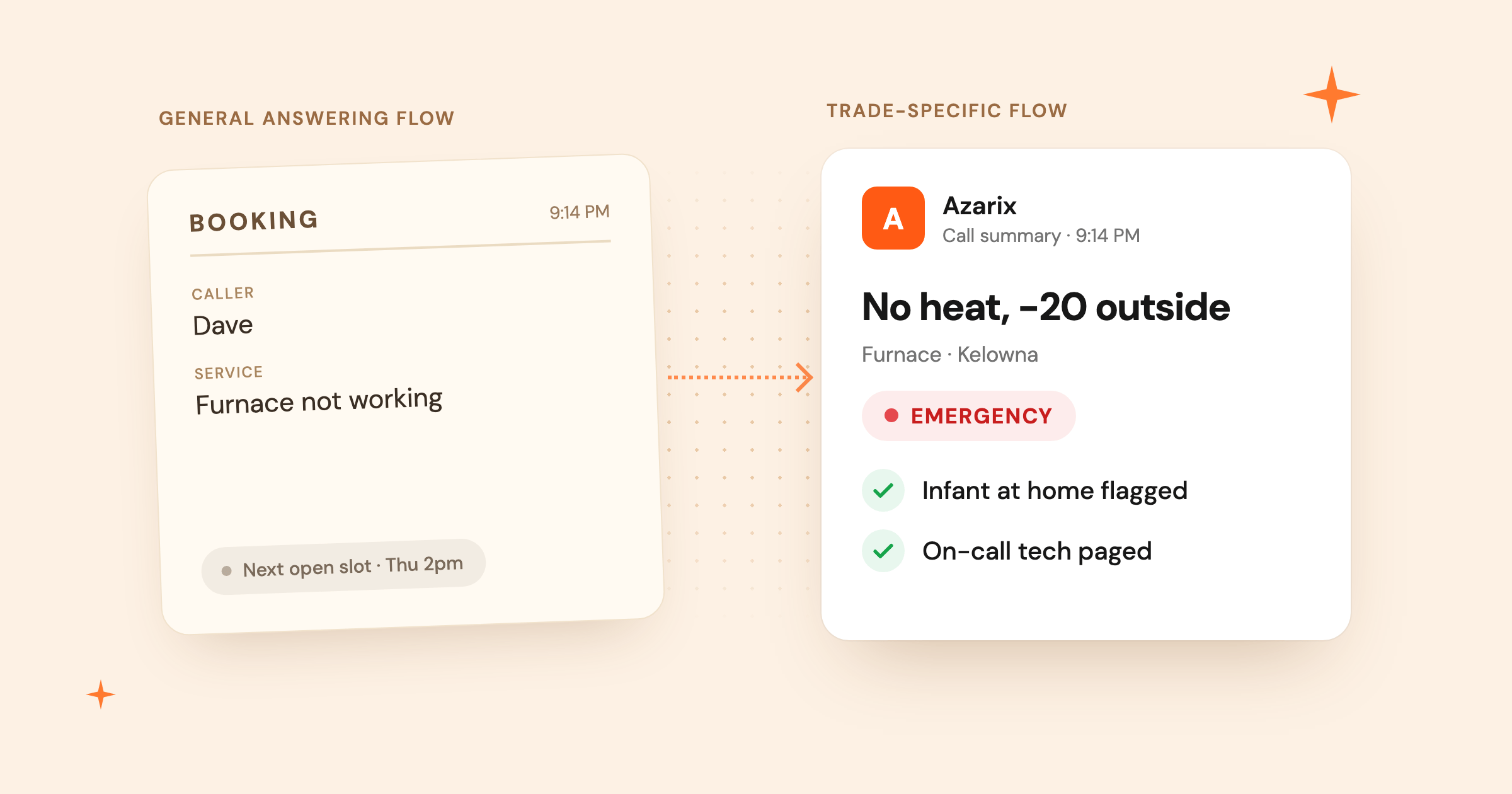
Best for a trades business that wants call handling built around the job type — emergency vs. routine, HVAC vs. electrical — not a general-purpose answering flow.
Best for a business that wants broad language coverage (26 languages) and a disclosed, no-surprise-charge call-pool structure without needing trade-specific booking logic.
Side-by-side
Azarix vs. Dialbox
7 buying differences, scored with a verdict per row instead of a flat checklist.
Azarix wins 3 of 7 scored differences
| Feature | Azarix | Dialbox | Verdict |
|---|---|---|---|
| Trade-specific call flowsDecides whether a no-heat call, a burst pipe, and a routine maintenance visit get handled differently on the phone. | Yes: Configured around the trade and call type | No: General-purpose answering flow, not built around a specific trade | Azarix |
| Bilingual and multilingual supportLanguage coverage matters for callers in Quebec, francophone communities elsewhere in Canada, or businesses serving multilingual customers. | Yes: English and French call support | Yes: English and French, plus real-time switching across 26 languages total | Competitor |
| Pricing and included call allowance (from)The lowest published monthly cost and how many calls it includes, so the comparison isn't just sticker price. | Yes: CA$79/mo annual, CA$99/mo no commitment, 100 calls included | Partial or conditional: CA$129/mo (≈CA$108/mo with 2 months free annual), 100 calls included | Azarix |
| What happens over the included call allowanceDecides whether a busy month costs more, gets throttled, or just needs a plan change. | Partial or conditional: Overage policy not yet published | Partial or conditional: Small protected grace buffer for short spikes; sustained overcap use should upgrade to the next plan; usage alerts at 70/90/100% | Tie |
| Canadian data residency / PIPEDACompliance and data-location trust for Canadian buyers handling customer call data. | Partial or conditional: PIPEDA + Law 25 compliant; calls processed by US sub-processors | Yes: PIPEDA-compliant, data stored in Canadian data centers | Competitor |
| Calendar and scheduling integrationsDetermines whether a booked job lands where the office already looks, without manual re-entry. | Partial or conditional: Google Calendar, Outlook / Gmail; Jobber sync on the roadmap | Yes: Google Calendar, Outlook, Calendly, Square, Acuity | Competitor |
| Revenue-recovery framingShows whether the product is positioned around answering the phone or around the booked, paid job that follows. | Yes: Priced against one booked emergency job as the break-even | No: Positioned as call answering; no published per-job or break-even math | Azarix |
What is the best Dialbox alternative for trades?
Dialbox is a real Canadian-first competitor, not a strawman. It launched in June 2025 as "Canada's First AI-Powered Voice Answering Service," and its current pricing page backs that up: disclosed tiers, two months free on annual billing, a 7-day trial that doesn't eat into your first paid call pool, and no hidden fees. For a business that wants calls answered in English, French, or one of 26 languages, Dialbox is a legitimate option.
The dividing line isn't whether the phone gets answered. It's what happens after. Dialbox's own pricing page positions the product around AI-handled call volume and a protected grace buffer for spikes. It doesn't publish a booking-outcome number or a break-even calculation. Azarix starts from the other direction: the plan is priced against one booked emergency job, because an answered call that doesn't turn into a booked job hasn't actually solved the problem.
See the current Azarix plans for what a trade-specific receptionist plan includes at each tier.
Where Dialbox is genuinely strong
Language coverage is Dialbox's clearest advantage. Real-time switching across 26 languages, with English and French as the Canadian baseline, goes beyond what most competitors in this space offer, Azarix included. If a business serves a genuinely multilingual customer base beyond English/French, that breadth is a real reason to choose Dialbox.
Dialbox's pricing is also disclosed in detail and, credit where due, fair. Four tiers (Core at $129/mo for 100 AI-handled calls, Pro at $299/mo for 300, Max at $699/mo for 900, and Managed from $999/mo for custom volume) are published on its site along with what happens near the ceiling: a small protected grace buffer for short spikes, usage alerts at 70%, 90%, and 100% of the plan, and a recommendation to upgrade for sustained overcap use rather than a surprise bill. Two months free on annual billing brings the effective Core rate to roughly $108/mo.
Canadian data residency and PIPEDA compliance are also table stakes done right: Dialbox states its data is stored in Canadian data centers, which matters for any business handling customer call data under Canadian privacy law.
Where does Dialbox fall short for trade-specific booking?
Dialbox's public pricing and product pages describe AI-handled call volume, not trade-specific call logic. There's no public documentation of adaptive questioning that changes by trade or urgency, the way a dispatcher would naturally handle an emergency furnace call differently from a routine cleaning booking.
Azarix starts with that call-level distinction. A no-heat call in an HVAC emergency should not follow the same path as a spring tune-up. A burst pipe should surface shutoff status and active damage before anyone offers a routine slot. The point isn't to ask more questions on the call. It's to ask the few that decide whether to book, dispatch, or escalate.
There's also a positioning gap. Dialbox's pricing page is built around call volume and grace buffers, not around what a booked job is worth. Missed calls carry a real cost for trades businesses, and a receptionist priced against that cost, rather than against call count alone, changes how you evaluate the plan.
Incoming call · HVAC
“No heat, and it's −20 out”
General answering flow
- Name and number
- Collected
- Service needed
- Heating
Next open slot offered
Same path as a routine tune-up
Trade-specific flow
- Urgency
- Emergency
- Any heat source?
- None
- Anyone vulnerable?
- Infant at home
Escalated to the on-call tech
Caller told exactly what happens next

Asks the few questions that decide it
Dialbox pricing, explained
As of August 20, 2026, Dialbox lists four tiers directly on its pricing page: Core at $129 CAD/mo for 100 AI-handled calls, Pro at $299/mo for 300, Max at $699/mo for 900, and Managed starting at $999/mo for custom volume. Annual billing gets two months free across all plans, which brings Core's effective monthly rate to roughly $108.
Dialbox's own pricing page describes what happens near the ceiling: inbound calls get a small protected grace buffer for short spikes, usage alerts fire at 70%, 90%, and 100% of the plan, and sustained over-cap use should move to the next plan or a Managed review rather than trigger a surprise charge. Outbound campaigns, by contrast, pause at the cap without the protected grace buffer. The 7-day trial tracks AI-handled calls separately, so trial usage doesn't reduce the first paid month's pool.
Azarix's published rates are CA$99/mo with no commitment or CA$79/mo billed annually, with 100 calls included on the entry Starter plan. Azarix's policy for calls beyond the included allowance is not yet publicly finalized, so that isn't a claim we make here — Dialbox's disclosed grace-buffer-and-upgrade approach is a genuinely fair structure, and any Azarix comparison on this point should wait until Azarix's own overage terms are public.
Both companies price in CAD, so no currency conversion is needed. Dialbox's annual figure reflects its published 2-months-free offer. Source: Dialbox pricing page and Azarix pricing page, checked August 20, 2026.
Prices are shown in the vendors’ published currencies and exclude applicable tax.
Who should choose Dialbox?
Choose Dialbox if language breadth beyond English and French is a real requirement for your callers, not a nice-to-have. Real-time switching across 26 languages is a genuine differentiator that a narrower, trades-focused product doesn't try to match.
Dialbox also makes sense if you want a disclosed, general-purpose call-pool structure with clear usage alerts and a fair grace buffer, and you don't need the AI to distinguish between call types the way a dispatcher would. Its pricing transparency, right down to what happens at 70%, 90%, and 100% of the plan, is a legitimately strong buying signal.
Who should choose Azarix?
Choose Azarix if the differences between calls matter more than raw call-answering volume: the conversation should change when the furnace is out at -20°C, water is actively spreading, or a caller is locked out. Those are operating decisions a general answering flow isn't built to make.
That focus has real limits. Azarix doesn't currently match Dialbox's 26-language breadth, and Azarix's own policy for calls beyond a plan's included allowance isn't public yet, so it can't be compared favorably or unfavorably to Dialbox's disclosed grace-buffer approach until it is. If broad language coverage or a fully disclosed overage policy today is the deciding factor, that's a fair reason to choose Dialbox instead.
A fair way to decide
Run the same calls through both. Start with a routine booking, then try an urgent HVAC call, interrupt mid-sentence, and change the address. Listen for whether the receptionist asks the few facts that actually decide dispatch versus a routine slot, not just whether it answers politely.
If multilingual reach beyond English/French matters for your callers, weigh that heavily — it's Dialbox's clearest advantage. If trade-specific call handling matters more, that's the gap this comparison is built around.
Try the Azarix live HVAC demo to hear the booking conversation directly, or browse other product comparisons if Dialbox isn't the only alternative on your shortlist.
Compare the actual call
Hear how Azarix handles an HVAC booking
Try the live call flow, interrupt it, change your answer, and see whether the next step still makes sense.
Open the HVAC demoFAQ
Dialbox questions
What is the best Dialbox alternative for trades businesses?
Azarix is a focused alternative for a trades business that wants call handling built around the job type — emergency versus routine — rather than general-purpose call answering. Dialbox remains a strong choice for broad language coverage and a disclosed, no-surprise call-pool structure.
How much does Dialbox cost?
As of August 20, 2026, Dialbox lists Core at $129 CAD/mo for 100 AI-handled calls, Pro at $299/mo for 300, Max at $699/mo for 900, and Managed from $999/mo for custom volume, all published directly on dialbox.ca/pricing. Annual billing includes two months free.
What happens if I go over my Dialbox call limit?
Dialbox's pricing page states inbound calls get a small protected grace buffer for short spikes, with usage alerts at 70%, 90%, and 100% of the plan. Sustained over-cap use should move to the next plan or a Managed review rather than trigger a surprise charge. Outbound campaigns pause at the cap without the grace buffer.
Does Dialbox book jobs or just answer/log calls?
Dialbox's public pages describe AI-handled call answering and volume, without documented trade-specific booking logic that adapts by job type or urgency. It is positioned around call handling rather than a per-job or break-even outcome.
Is Dialbox bilingual?
Yes, and beyond bilingual: Dialbox supports English and French plus real-time switching across 26 languages total, which is broader than most competitors in this space, including Azarix's current English/French support.
Is Azarix cheaper than Dialbox?
At the entry tier, yes: Azarix is CA$79/mo annual or CA$99/mo no commitment with 100 calls included, versus Dialbox Core at roughly CA$108/mo annual or CA$129/mo no commitment with 100 calls included. Compare included call counts alongside price, not price alone.
Does Dialbox have industry-specific call flows for HVAC, plumbing, or electrical?
Dialbox's public product documentation does not describe trade-specific or adaptive call flows by industry. Azarix configures call handling around the trade and call type, such as differentiating a no-heat emergency from a routine maintenance visit.
Research notes
We compared current public pricing and product pages for both companies, fetched directly rather than relying on older press coverage. Both companies price in CAD, so no currency conversion was needed. We did not use paid placements, customer ratings, or features that could not be verified on each company's own site.
Sources
- Dialbox pricingCurrent tiers, included call allowances, overage and grace-buffer policy, trial terms.
- Dialbox launch announcementLaunch date and original positioning; historical context only, not used for current pricing.
- Azarix pricingCurrent Azarix plans and included call allowances.
Disclosure: Azarix wrote this comparison. We build an AI receptionist for trades businesses, so we have a stake in the choice. The Dialbox details below come from Dialbox's public pricing and product pages.